Customer case studies with before and after metrics
Most customer stories fail for a simple reason. They say a client was happy, but they never show what changed in a way a reader can actually measure.
That is why before and after metrics matter. Want they turn vague praise into something useful, whether you are writing for a local service business, an online shop, or a B2B company trying to prove that SEO work led to real progress.

Why before and after metrics make case studies believable
A customer case study works best when it answers the question a reader already has in mind. Did anything improve, and can I see the difference clearly.
Before and after metrics do that job better than adjectives. Words like successful, impressive, or game-changing sound polished, but they do not help someone judge whether the result is relevant to their own situation.
In SEO, the gap is often even wider. Many businesses pay high monthly fees, wait weeks for content, and still get reports that are heavy on activity but light on outcomes. A case study with real metrics cuts through that. It shows what traffic looked like before, what lead volume looked like after, and what changed in rankings, clicks, or conversions.
This is also why strong success stories tend to perform well as SEO content themselves. They match informational search intent, they build trust, and they often attract readers who are comparing options carefully. For local businesses and growing brands, that trust is often more persuasive than a generic service page.
What counts as a strong metric in a success story
Not every number belongs in a case study. A strong metric is one that connects directly to the customer problem and the business outcome.
If the problem was expensive SEO retainers, a useful metric might be monthly content cost before and after. If the issue was slow delivery, time to publish is a better metric than total impressions. Dus if the business struggled to show up in AI search tools, visibility in ChatGPT, Perplexity, or branded search demand may be part of the story.
For SEO, common before and after metrics include organic clicks, indexed pages, ranking movement for target keywords, conversion rate from organic traffic, calls or form submissions, and time saved in content production. For local context, you can also include map visibility, service-page traffic, and lead quality by region or service type.
The best metric set is usually small. Three to five numbers are enough if they are well chosen. Too many figures can make a story feel defensive. A few relevant metrics, paired with clear context, feel more honest and easier to remember.
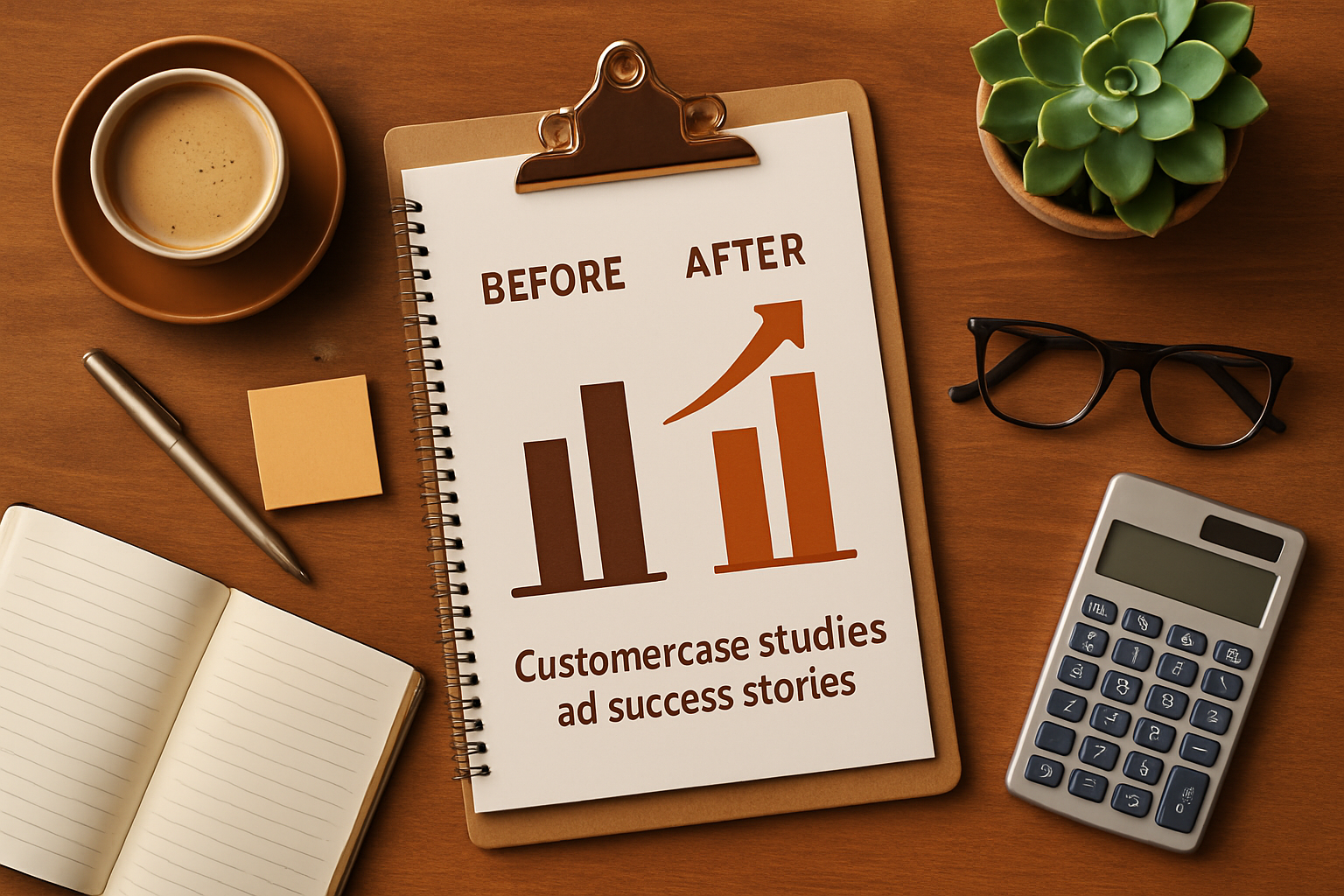
A simple structure that keeps the story clear
A good customer success story does not need to be dramatic. It just needs to be easy to follow.
Start with the customer situation. Describe the business type, the challenge, and the constraints. Keep this grounded. A reader should quickly recognize the situation, such as paying €500 to €2000 per month for bureau work, waiting too long for articles, or being stuck in a rigid contract with limited output.
Then move to the before picture. This is where you show the baseline metrics. Be specific about the time frame and the starting point. Saying traffic was low is weak. Want saying organic clicks averaged 420 per month over the previous quarter is much stronger.
After that, explain what changed. This is where methods matter. If AI-generated content was used, mention quality controls like E-E-A-T principles. Dus if schema markup was added, explain which types were implemented and why. If automatic publishing, internal linking, or keyword analysis played a role, say so plainly.
End with the after picture. Show the measurable outcomes and include one short customer quote if you have it. That basic shape is also a practical customer success story template because it keeps emotion and evidence in balance.
How to interview customers without getting bland answers
The quality of a case study usually depends on the interview. If the conversation stays vague, the final story will stay vague too.
A useful customer success case study interview starts with context, not praise. Ask what was happening before they looked for a solution. Want ask what was frustrating, what had been tried already, and what felt too expensive, too slow, or too complicated. That is where the real story usually begins.
Then ask for specifics. Which pages mattered most. How long did content delivery take before. Dus how many articles could they publish each month. What happened to lead flow, calls, or quote requests after the new process was in place. If possible, confirm those answers against analytics, Search Console, CRM data, or publishing records.
It also helps to ask what surprised them. Sometimes the strongest detail is not the biggest metric. It may be that article production became predictable, schema markup no longer needed manual work, or category syncing in WordPress removed repetitive admin tasks. Those details make a story feel lived in rather than polished for marketing.
Examples that feel real without becoming overproduced
Many people search for how to write a success story about a client example because they want something concrete. The problem is that most examples online sound too neat. Real progress is often messier, and that is fine.
A useful example might describe a business that relied on an SEO bureau but could only publish a handful of articles each month. The before metrics could show limited organic growth, slow turnaround, and a rising cost per published page. Maar the after metrics could show faster publishing, more consistent content output, better internal linking, and a lift in non-branded clicks over six months.
Another example might focus on local discoverability. A company adds structured schema markup such as FAQ, LocalBusiness, Product, or Review, then combines that with better keyword targeting and automatic publishing. The result may not be a dramatic overnight jump, but a steady rise in impressions, richer search features, and more qualified enquiries.
This applies beyond clients too. Success story examples for employees often follow the same pattern. There is a challenge, a change in process, and a measurable result. The principle is universal. Readers trust progress they can follow.
How case studies support SEO and GEO at the same time
Case studies are not just sales assets. They can become strong organic content when they are written around real questions people search for.
Someone looking up customer success story template, real life inspirational stories of success, or customer case studies is often trying to understand what good evidence looks like. That makes the format a natural fit for informational search intent. A well-structured page can rank, earn links, and help readers who are still early in their decision process.
There is also a newer layer to think about. GEO, or Generative Engine Optimization, matters because AI search tools summarize and compare information differently from traditional search engines. Pages with clear structure, explicit outcomes, and supported claims are easier for systems like ChatGPT and Perplexity to interpret and cite.
This is where the mechanics behind the page start to matter. Schema markup, clean headings, internal linking, and consistent publishing all improve discoverability. Platforms like SEO AutoPilot EN build this into one workflow, which is useful for teams that want articles, optimization, and analytics in one place instead of spread across agencies and tools.
Common mistakes that weaken trust
The biggest mistake is using numbers without context. Saying traffic increased by 300 percent sounds impressive until a reader learns it rose from 10 visits to 40. Relative growth matters, but absolute numbers matter too.
Another problem is skipping the before state. Without a baseline, the after metrics feel detached. Readers need to understand what changed, over what period, and under which conditions. If seasonality, a site migration, or a new offer influenced the result, say that openly.
Some case studies also try too hard to sound universal. They imply one tactic works for everyone. In practice, a local service business, a national webshop, and a B2B software company will not measure success in the same way. Strong stories respect that difference.
There is also a habit of hiding process details. That usually backfires. Readers do not need every technical setting, but they do want to know whether results came from better keyword analysis, more frequent publishing, smarter internal linking, schema improvements, or content refreshes after decay. Clarity creates trust. Mystery rarely does.
Video: A framework for writing compelling customer success stories (business case studies)
Voordelen op een rij
- Start with the baseline: show the real before situation with time frame, traffic, leads, costs, or publishing speed.
- Pick relevant metrics: use three to five numbers tied directly to the customer problem and business goal.
- Explain the method: describe what changed, such as AI SEO content, schema markup, keyword analysis, or automatic publishing.
- Keep the story grounded: add constraints, tradeoffs, and context so the result feels credible rather than staged.
- Use short customer quotes: one honest sentence often adds more trust than a full page of praise.
- Write for search and humans: structure the page clearly so it works for readers, Google, and AI search engines.
A practical way to think about proof
There is a reason readers keep looking for real examples. They are not only searching for inspiration. Dus they are trying to reduce uncertainty.
That is what a good case study does. It gives shape to a decision. Dus it shows what the problem looked like before, what changed in the middle, and what happened after enough time had passed to measure the result.
For teams producing SEO content at scale, that proof becomes even more important. AI can speed up research, drafting, publishing, and optimization. But readers still want signs of judgment. They want to see that the content is built around actual business outcomes, not just volume.
That is why the best case studies are rarely flashy. Toch they are clear, specific, and calm. They respect the reader enough to let the numbers speak, then explain what those numbers mean.
What to take from all this
If you want customer stories that people trust, start with reality rather than polish. Show the baseline, explain the process, and use metrics that match the problem the customer was trying to solve.
That approach works whether you write the page yourself or use a platform to streamline content, publishing, and optimization. The point is not to make the result look bigger than it is. Dus the point is to make it understandable.